





Fabric Material:
- 100% Certified Organic Cotton ring-spun jersey
- Light fabric (5.3 oz/yd² (180 g/m²))
- Runs true to size
6 Easy Step To Grab This Product:
- Click the button “Buy this shirt”
- Choose your style: men, women, toddlers, …
- Pic Any color you like!
- Choose size.
- Enter the delivery address.
- Wait for your shirt and let’s take a photograph.
Shipping:
It takes 1-3 days to fulfill an order, after which it’s shipped out. The shipping time depends on your location, but can be estimated as follows: USA: 2-7 business days International: 10-20 business days. Available Size: XS, S, M, L, XL, 2XL, 3XL, 4XL, 5XL Available Color: Black, Cardinal Red, Forest Green, Gold, Navy, Royal, Sport Grey, White…STORAGE INSTRUCTIONS:
Do not use detergent containing chlorine, Do not use detergent, Drying, normal temperature, low heat. Regular ironing can be done by steam or dry ironing, and ironing cannot be more than 110 degrees Celsius. Delivery Your order will be printed exclusively for you within a few days. If you are in the US, Canada or Europe, you will receive your order within 3-7 business days after printing is complete. For all other countries, please allow between 10-14 business days. And you wanna design your own shirt by yourself for your team, your group or your family, you can sent us your design to gmal address [email protected].. We will make it for you. This shirt the official design from Hulktee.com. Available for T-shirt, hoodie, tank top, long sleeve, sweater, youth tee, onesie for men and women. Have a nice day!| SHIPMENT METHOD | PROCESSING TIME | ESTIMATED DELIVERY TIME | SHIPMENT COST |
|---|---|---|---|
| Domestic US | 1-3 business days | 2-5 business day | USA First Hoodie or Sweat: $8 Additional Hoodie or Sweat: $2 First Shirt: $5 Additional Shirts: $2 |
| International | 2-5 business days | 10-20 business day | International Hoodie or Sweat: $10 Shirt: $8 |
| SHIPMENT METHOD | PROCESSING TIME | ESTIMATED DELIVERY TIME | SHIPMENT COST |
|---|---|---|---|
| Domestic UK | 1-3 business days | 2-5 business day | UK First Hoodie or Sweat: $8 Additional Hoodie or Sweat: $2 First Shirt: $5 Additional Shirts: $2 |
| Europe | 1-3 business days | 10-20 business day | Europe First Hoodie or Sweat: $8 Additional Hoodie or Sweat: $2 First Shirt: $5 Additional Shirts: $2 |
There is no new story to tell about an eating disorder. Or, at least, that’s what it sometimes feels like to those of us who have them; one of the Miami dolphins football est 1966 shirt in contrast I will get this hallmarks of eating disorders are their inherent sameness, the way they flatten the world, turning its wild and unpredictable majesty into a formulaic arrangement of calories taken in and burned off. If a story’s value lies in its uniqueness—then how do you tell this one? How do you make a story that’s familiar to approximately 9% percent of Americans stand out?Nobody knows that predicament better than Melissa Broder, whose latest novel Milk-Fed—a profoundly sexy yet deeply sad exploration of an anorexic Hollywood assistant’s amour fou with a zaftig Orthodox Jewish frozen-yogurt server—is out this week. Broder’s book is appearing at a time when people who struggle with disordered eating are having to manage the twin stresses of pandemic-induced isolation and uncertainty.”I have an inability to be still with myself,” admits Broder, whose 2016 memoir So Sad Today catapulted her from a prominent voice on “sad-girl Twitter” to a bona fide authority on what it means to be young, funny, depressed, and in possession of a WiFi connection. Broder’s first novel, The Pisces, did the near-impossible work of turning what should be a punchline—a woman has sex with a merman!—into a carefully observed and painfully emotive masterwork.Broder’s sophomore effort, Milk-Fed, gathers strands of faith, hunger, queerness, lust, and loneliness and braids them into a fully risen challah of human experience. If good reading requires, as critic Dwight Garner once wrote, that we “submit to the spell being cast,” then Broder’s view of the world requires more than its share of submitting. Broder doesn’t pull her punches; you feel the desperate daily grind of protagonist Rachel’s hunger on every page. But alongside this struggle is a carnal lust that soars off the page, calling into question what it really means to desire.Broder and I are scheduled to connect via phone in December, and—bearing in mind that we have Jewish heritage and eating disorders in common—I invite her to first attend a Zoom event titled “Drippings: An Embodied & Erotic Chanukah Celebration of Fat,” in which, among other things, speakers discuss “Jewish relationships toward fat and bodies” and attendees are encouraged to eat as part of a ritual to “deepen our sensory embodiment.” WiFi issues force me to leave Broder to her own devices for most of the event while I continually attempt to reconnect. Luckily, she’s a veteran of such spaces as a resident of Venice, California, an L.A. neighborhood she refers to as “the heart of the self-love industrial complex.”“The question the book is asking is: What are we being fed? Whose voice is this in my head?”“Anytime I hear the phrase ‘holding space’ three times in five minutes, well…”, Broder chuckles. Still, she tells me, she actually found the Zoom event inspiring. “My Judaism is few and far between, but I’m kind of a pyro, so Chanukah is really the holiday for me.” Broder has written frequently about the Cali-inflected form of spirituality that expresses itself through expensive incense and designer crystals, but Milk-Fed approaches religion with less snark and more openness. Rachel comes from a Jewish family, but she prays primarily to the all-too-seductive god of thinness, seeing Judaism less as a faith than as a collection of dense, highly caloric deli-counter treats.Broder’s own feelings about growing up culturally Jewish and full of angst in Bryn Mawr, Pennsylvania are alluded to in Milk-Fed: Rachel gets in a climactic fight with her secret girlfriend Orthodox family about the implications of Israeli occupation, for example. But the novel is less about traditional religious dogma than the more atheistic rules we force ourselves to live by. “The question the book is asking is,” Broder says, is “‘What are we being fed? Whose voice is this in my head?’ First, you have to even notice that there’s a voice inside you that isn’t necessarily a cosmic arbiter or the voice of God,” she adds. “It’s a perspective, right? That voice may not be the voice of truth.”The notion of a higher power is central to both a religious and eating-disorder-prone mentality, and Broder has written frequently about turning the latter into the former. “I am an eater who feels safest at a place of very thin,” she wrote in So Sad Today; in that book, she detailed her experiences with anorexia, binge eating, laxatives, and a host of other hallmarks of disordered eating. Milk-Fed’s preoccupation with what Rachel is and isn’t eating can be, at times, exhausting—in the way that actually suffering from an eating disorder can be exhausting—but Broder sees eating disorders as a kind of “monotheistic religion,” and her refusal to allude circuitously to Rachel’s problems in forgiving ellipses is strangely invigorating.When Broder describes her own passage into sobriety, which she eventually found her way to in her twenties, she does so in terms of joy—and appetite: “I wanted to sample what the world had to offer, and this included food.” This is the central conflict at work in Milk-Fed, the tension between skinny, miserable Rachel and her unabashedly fat lust object Miriam. Miriam is able to experience genuine pleasure in food—pleasure that satisfies in the moment, and, necessarily, passes—while Rachel can’t let herself enjoy even some soft-serve frozen yogurt without turning it into a full-on binge, followed by a starvation ritual.Food and sex can each be painful vices or sources of profound joy, depending on who’s partaking and how.The fat-skinny binary in Milk-Fed is complicated by Rachel and Miriam’s illicit, feverish attraction to one another, and it’s in their interaction that the best part of Broder’s writing—the sex!—announces itself with aplomb. Food and sex can each be painful vices or sources of profound joy, depending on who’s partaking and how, and the land of ascetic misery that Rachel dwells in when her eating disorder flares up looks all the more grim when it’s compared to the lush, abundant passion she’s briefly able to find with Miriam. Sex fills Rachel in a way that food never can, it’s implied—but what does it mean to substitute one sensory god for another?“I’m very attracted to Miriam,” Broder confesses, adding, “In order for me to write sex stuff, I do have to turn myself on.” The personal history of sexual anxiety that Broder conjured in So Sad Today finds its most natural expression in Milk-Fed, with Rachel and Miriam engaging in sex that blurs the boundaries between what they want and what they’ve been taught to want. Broder possesses a gift for turning the banal beautiful, and that gift is never more apparent than when she’s wringing genuine emotion out of an encounter between a woman and a merman, or two confused Jewish girls in an L.A. studio apartment.Broder is more than willing to discuss her various characters’ sexual predilections as though we’re gossiping about mutual friends at a pre-pandemic party: “I think Lucy [from The Pisces] is definitely fairly hetero, but is fluid in the sense that she can get off on a fish. Rachel is bisexual, but she’s at a point in her life where she’s leaning away from hetero on the Kinsey scale.” Broder seems serene about her own sexual identity, calling herslf bisexual primarily because “pansexual” sounds, to her, “like something you have to be Miley Cyrus’s age to pull off.” (Broder is currently seeing The Pisces developed for TV, with Obvious Child director Gillian Robespierre at the helm and Claire Foy set to star. Robespierre describes the story to me as “intense, slightly disturbing, funny, and very human.” Director Liz Tigelaar recently nabbed the rights to Milk-Fed.)If Broder’s past work has been about the perversity of desire in all its forms, Milk-Fed is about its embrace—and the way that embrace can be a kind of faith in itself. But Broder is careful not to be too precious about the definition of faith. “We all have gods,” she says. “Everyone in Milk-Fed has a god, it’s just that often their denominations stray from the theological. There are gods that are made of familial approval, success, validation, money, love. We all make something into a higher power. Who are your gods?” Milk Fed ends with Lucy, healing but not necessarily “better,” grieving but upright. And what is faith, if not something that keeps us standing?
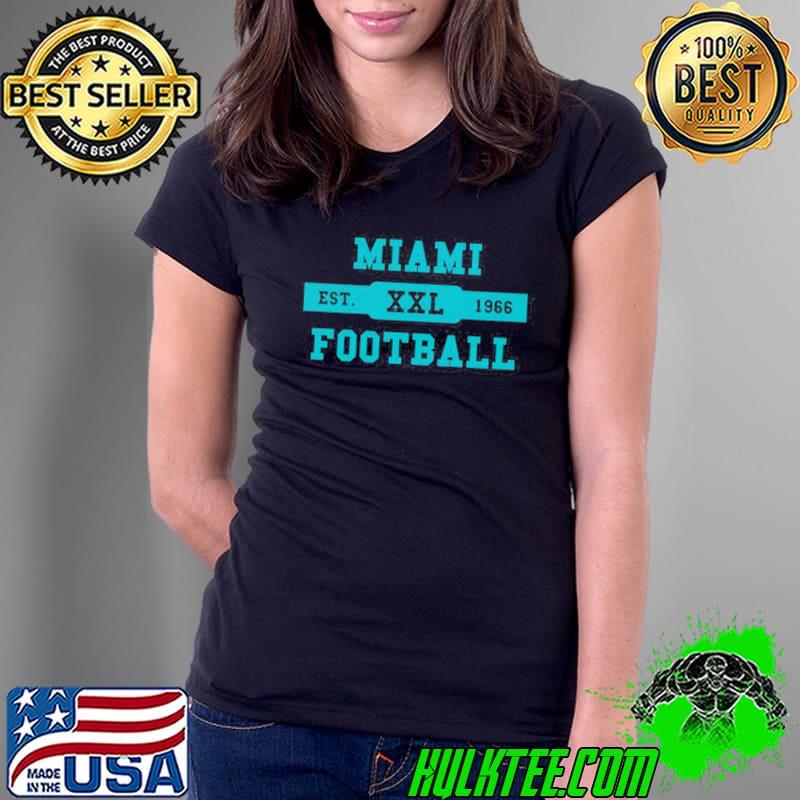
Miami dolphins football est 1966 shirt, hoodie, tank top, sweater and long sleeve t-shirt
You might know Gabrielle Korn’s byline from her work for Autostraddle, Refinery29, InStyle, and a host of other digital media publications where she’s written about everything from the Miami dolphins football est 1966 shirt in contrast I will get this beauty industry to living as a lesbian with an eating disorder and the insidious cult of low-rise jeans.If not, you might remember Korn from her tenure as the youngest-ever editor in chief of Nylon Media, where she was also one of the only openly queer people on the upper echelons of a media masthead. On Tuesday, Korn—who is currently the editorial and publishing lead of Netflix’s LGBTQ+ storytelling channel, The Most—published Everybody (Else) Is Perfect, a chronicle of her time falling in and out of love with the media industry, beauty, fashion, and a few different women along the way. This week, Vogue spoke to Korn about the experience of writing so openly about her own life, the strangeness of debuting a memoir in a pandemic, and her vision of what the future of LGBTQ+ media could look like.Vogue: First of all, what has the experience of releasing your debut book into a pandemic been like? Obviously, nobody could have predicted this, but did you imagine what this time would be like while you were writing?Gabrielle Korn: I did picture the book coming out, but it was so long ago. When I got the book deal, I was still the editor in chief of Nylon, so my life was different in every single way. The vision that I had for it is in no way what is happening, on any level. And I think in a lot of ways, that’s a good thing. Having a pandemic book launch is depressing, but I’m also so grateful for all of the support. I’ve been talking to my friends about how guilty I feel about all the self-promotion, and they’re just like, “Yeah, but just do it.”Corny question: How are you making space for joy in this bizarre time?I’ve always been very routine oriented, and because I’m working on West Coast time, I have mornings to myself. So I’ve been doing my, like, stupid little Zoom workouts every morning and keeping to some semblance of a schedule because if I don’t, I’ll just move from the couch to the bed and back.Your book zeroes in on so many of the hypocrisies and inequities of digital media while also displaying real love for it as well. Is there anything you wanted readers to come away knowing about the industry?The fashion and digital media industries have been so glorified, and I think it’s really important for people to understand that work is work. Also, when you have an industry that basically runs on creating free content, it’s not going to be a sustainable working environment for the people making that content. I wanted to peel back the curtain on that—am I mixing my metaphors?No, that works.I feel like so many young people want to get into this industry as their ultimate aspiration, and what I really wanted to do was give them permission to have dreams that are larger than media. I think it’s so hard for us, especially as people who want to write, to imagine anything bigger than writing for a publication, but the truth is it can be a stop along the way.Is there anything that’s giving you hope about media now?Well, the conversations around racism in media that happened over the summer are so overdue and so important. I think those had a huge impact. And with leadership changes in a lot of places, I feel hopeful, but what needs to happen now is a hiring and retention emergency. Companies need to figure out why people of color don’t stay, and they need to fix the problems that are causing them to leave.You and I have talked about this before, but there are so few out lesbian role models in media. What does it feel like to be one of them?It’s weird! It’s funny to be old enough that people look up to me. I’ll probably never get over that. I mostly feel really proud of it. Sometimes it feels like a burden, but it’s also such a gift.What do you want for LGBTQ+ folks in media that you don’t already see out there?What I’ve seen in [LGBTQ+] representation recently is an enormous push to have queer and trans people, and especially queer and trans people of color, in front of the camera. And I think that’s great and important. But we also need those people behind the camera; we need them on staff making decisions and telling the stories of their own communities in a way where they’re not tokenized. You can’t have diversity that’s just superficial; if your idea of diversity is just what people can see, then you’re just doing it for clout.I know you got your start at Autostraddle, but I’m wondering what other queer resources you wish you had when you were younger?I wish that I had a media landscape that acknowledged that lesbians exist, which I think has only recently started to happen. Wasn’t it you who wrote the article about Shane [from The L Word]?Yes, that was me!I feel like that was when I knew Vogue had a lesbian writer on staff. Unfortunately, people who are not from marginalized communities often make the mistake of thinking that being a member of a community makes you an expert on all parts of that community. So the one lesbian at every company is often tasked with speaking for LGBTQ+ people as a whole. And that’s not how this works.As a queer person, what makes you feel like you’re taking up the kind of space that makes you genuinely proud?Passing the mic, honestly. I know that’s an ironic thing to say while I’m in the middle of promoting my own book. But there came a point where I just felt like I should not be the face that people associate with Nylon. That time is over, it should be over. So I started using my position to elevate other people—whether it was people on staff, or artists, whoever—and that felt really good to me because it was like, Okay, I am a queer person who got in the door, I have a seat at the table. Now what I need to do with that seat is make more room.You write so openly and fearlessly about your experience with disordered eating. How did you get yourself in a mental place to do that?It was really hard. I had been in a lot of treatment, including work with a therapist, a psychiatrist, a nutritionist, and a physician. I started out just writing about recovery because I didn’t really want to talk to anybody about it. So I already had all of the honest, raw writing about it when I began the book. It actually became a matter of paring it back and thinking about, What is helpful for other people? What could accidentally be harmful? What do I feel comfortable with strangers knowing? What will it feel like to have people read this?Did you want your memoir to be in conversation with anything else that’s on there?When you’re writing, I feel like you either have to read everything or nothing on the topic, but there were a couple things that really inspired me. One was Hunger by Roxane Gay—the frankness with which she writes about food was really inspiring. And then Michelle Tea came out with a book of essays right when I started mine, and I was really inspired by the way she talked about pop culture as a way to talk about what her life was like when that piece of pop culture came out. That’s when I decided to do, like, a section about my love for Bright Eyes when I was 14. It was like, Oh, you can just talk about a band you love? And use it as a way to talk about what’s happening?
Be the first to review “Miami dolphins football est 1966 shirt”
You must be logged in to post a review.
- Length from the highest point of the collar to the bottom hem.
- Chest straight across, armpit to armpit, with the shirt laid flat.
- Sleeve from the center back of the collar to the cuff.
| Size | Length | Chest |
|---|---|---|
| S | 2871 | 1846 |
| M | 2974 | 2051 |
| L | 3076 | 2256 |
| XL | 3179 | 2461 |
| 2XL | 3281 | 2666 |
| 3XL | 3384 | 2871 |
| 4XL | 3486 | 3076 |
| 5XL | 3589 | 3281 |
| Size | Length | Chest |
|---|---|---|
| S | 2564 | 1641 |
| M | 2666 | 1743 |
| L | 26.567 | 1846 |
| XL | 2769 | 19.750 |
| 2XL | 27.971 | 21.655 |
| 3XL | 28.572 | 22.758 |
| Size | Length | Chest |
|---|---|---|
| S | 2871 | 1846 |
| M | 2974 | 2051 |
| L | 3076 | 2256 |
| XL | 3179 | 2461 |
| 2XL | 3281 | 2666 |
| 3XL | 3384 | 2871 |
| Size | Length | Chest | Sleeve |
|---|---|---|---|
| S | 2666 | 2051 | 33.585 |
| M | 2769 | 2256 | 34.588 |
| L | 2871 | 2461 | 35.590 |
| XL | 2974 | 2666 | 36.593 |
| 2XL | 3076 | 2871 | 37.595 |
| 3XL | 3179 | 3076 | 38.598 |
| 4XL | 3281 | 3281 | 38.598 |
| 5XL | 3486 | 3384 | 38.598 |
| Size | Length | Chest | Sleeve |
|---|---|---|---|
| S | 2769 | 2051 | 34.588 |
| M | 2871 | 2256 | 35.590 |
| L | 2974 | 2461 | 36.593 |
| XL | 3076 | 2666 | 37.595 |
| 2XL | 3179 | 2871 | 38.598 |
| 3XL | 3281 | 3076 | 3999 |
| 4XL | 3384 | 3281 | 39.5100 |
| 5XL | 3486 | 3486 | 40102 |
| Size | Length | Chest | Sleeve |
|---|---|---|---|
| S | 2871 | 1846 | 33.585 |
| M | 2974 | 2051 | 3589 |
| L | 3076 | 2358 | 36.593 |
| XL | 3179 | 2461 | 3897 |
| 2XL | 3281 | 2666 | 39.5100 |
| 3XL | 3384 | 2871 | 39.5100 |
| Size | Length | Chest |
|---|---|---|
| S | 2769 | 1846 |
| M | 2871 | 2051 |
| L | 2974 | 2256 |
| XL | 3076 | 2461 |
| 2XL | 3179 | 2666 |
| Size | Youth size | Length | Chest |
|---|---|---|---|
| S | 6-8 | 20.552 | 1641 |
| M | 10-12 | 2256 | 1743 |
| L | 14-16 | 23.560 | 1846 |
| XL | 18-20 | 2564 | 1948 |
| Size | Youth size | Length | Chest |
|---|---|---|---|
| S | 6-8 | 2153 | 1743 |
| M | 10-12 | 22.557 | 1846 |
| L | 14-16 | 2461 | 1948 |
| XL | 18-20 | 25.565 | 2051 |








Reviews
There are no reviews yet.