




Fabric Material:
- 100% Certified Organic Cotton ring-spun jersey
- Light fabric (5.3 oz/yd² (180 g/m²))
- Runs true to size
6 Easy Step To Grab This Product:
- Click the button “Buy this shirt”
- Choose your style: men, women, toddlers, …
- Pic Any color you like!
- Choose size.
- Enter the delivery address.
- Wait for your shirt and let’s take a photograph.
Shipping:
It takes 1-3 days to fulfill an order, after which it’s shipped out. The shipping time depends on your location, but can be estimated as follows: USA: 2-7 business days International: 10-20 business days. Available Size: XS, S, M, L, XL, 2XL, 3XL, 4XL, 5XL Available Color: Black, Cardinal Red, Forest Green, Gold, Navy, Royal, Sport Grey, White…STORAGE INSTRUCTIONS:
Do not use detergent containing chlorine, Do not use detergent, Drying, normal temperature, low heat. Regular ironing can be done by steam or dry ironing, and ironing cannot be more than 110 degrees Celsius. Delivery Your order will be printed exclusively for you within a few days. If you are in the US, Canada or Europe, you will receive your order within 3-7 business days after printing is complete. For all other countries, please allow between 10-14 business days. And you wanna design your own shirt by yourself for your team, your group or your family, you can sent us your design to gmal address [email protected].. We will make it for you. This shirt the official design from Hulktee.com. Available for T-shirt, hoodie, tank top, long sleeve, sweater, youth tee, onesie for men and women. Have a nice day!| SHIPMENT METHOD | PROCESSING TIME | ESTIMATED DELIVERY TIME | SHIPMENT COST |
|---|---|---|---|
| Domestic US | 1-3 business days | 2-5 business day | USA First Hoodie or Sweat: $8 Additional Hoodie or Sweat: $2 First Shirt: $5 Additional Shirts: $2 |
| International | 2-5 business days | 10-20 business day | International Hoodie or Sweat: $10 Shirt: $8 |
| SHIPMENT METHOD | PROCESSING TIME | ESTIMATED DELIVERY TIME | SHIPMENT COST |
|---|---|---|---|
| Domestic UK | 1-3 business days | 2-5 business day | UK First Hoodie or Sweat: $8 Additional Hoodie or Sweat: $2 First Shirt: $5 Additional Shirts: $2 |
| Europe | 1-3 business days | 10-20 business day | Europe First Hoodie or Sweat: $8 Additional Hoodie or Sweat: $2 First Shirt: $5 Additional Shirts: $2 |
There’s a photograph of Wafa Ghnaim, as a a toddler, helping pull the Funny Trump Everything Woke Turns to Shit Political T-shirt and I love this excess canvas from her mother’s embroidery project. In the photo, which was taken in Massachusetts, she’s the same age that her mother, Feryal Abbasi-Ghnaim, was in 1948, when a radio broadcast told her family to leave their home in the mountain village of Safad, near the Sea of Galilee, for a few days. Thinking they’d be back, Ghnaim’s grandparents left behind their nicest clothes, including dresses intricately embroidered with tatreez, traditional Palestinian cross-stitch. When it became clear that they wouldn’t be returning home anytime soon, Abbasi-Ghnaim’s mother and grandmother began teaching her the techniques, and the stories, behind each of the embroidery patterns. In turn, Abbasi-Ghnaim passed the tradition down to her three daughters.Today, Ghnaim has carried the tradition even further—passing her knowledge of tatreez down to thousands of students across North America. The author of Tatreez & Tea: Embroidery and Storytelling in the Palestinian Diaspora, an oral history of her family and the tatreez patterns her mother passed down, Ghnaim currently teaches workshops at the Smithsonian Museum and serves as an artist in residence at the Museum of the Palestinian People in Washington, D.C. She’s also hard at work on her second book, documenting tatreez patterns in the collections of major museums and private collections. For her, teaching tatreez is a way to preserve her family’s culture and humanize the Palestinian experience.“If you know nothing about Palestinians besides what you’ve heard on the news and you attend one of my classes, you will have just stitched with me for two or three hours and heard my stories,” Ghnaim says. “There’s a humanity there.”The story of how Ghnaim and her mother became two of the world’s leading guardians of tatreez tracks closely alongside Palestinians’ history. Abbasi-Ghnaim was just a toddler when her family left their home and walked to the Jordanian border, during what Palestinians call the Nakba (Arabic for “catastrophe”), following the 1948 war of the end of the British Mandate for Palestine. A bus took them the rest of the way to Damascus, Syria, where they lived for a few years before joining family in Irbid, Jordan. In Jordan, Abbasi-Ghnaim’s mother and grandmother began embroidering again and Abbasi-Ghnaim started learning tatreez in the school she attended, run by UNRWA (United Nations Relief and Works Agency for Palestine Refugees in the Near East). She still has the first project she ever finished: a peacock she embroidered in the first or second grade.By the time Abbasi-Ghnaim graduated from school, she was an expert embroiderer working on her first thobe, a dress decorated with a wheat pattern, which she would eventually pass down to Ghnaim. When her father died unexpectedly, Abbasi-Ghnaim started working as a teacher in the refugee camps to support her family, teaching tatreez to Palestinian children “to make them connected to their tradition, to their culture,” she says, from Milwaukie, Oregon, where she now lives.Eventually, Abbasi-Ghnaim married, and in 1979 she and her husband immigrated to the United States. In Cambridge, Massachusetts, those first few years, Abbasi-Ghnaim was lonely and afraid to tell anyone that she was Arab and Muslim. But then she joined a women’s group called the Cambridge Women’s History Oral History Center and began to teach tatreez to other women from across the world who had come to call Massachusetts home, with her three young daughters acting as her assistants. There, she led the women in embroidering tapestries detailed with experiences from their lives. The tapestry Abbasi-Ghnaim embroidered would eventually be exhibited at the United Nations’ 1985 World Conference on Women in Nairobi, Kenya.Later, after the Ghnaim family had moved to Oregon and their daughters had grown into teenagers, Abbasi-Ghnaim received support from the Oregon Folklife Network to formally teach her daughters tatreez. When her girls were little, she had begun embroidering another thobe but found she never had time to work on it. Now that they were older, she pulled the dress out of storage and guided her daughters through the design, teaching them the stories of each pattern.Tatreez “is unwritten language, transferred stories between woman and woman in silence,” says Abbasi-Ghnaim. When formal schooling in reading and writing was limited to men, Palestinian women learned to tell their stories through embroidery. “We want to keep the stories alive.”In 2016, when Ghnaim sat down to begin writing Tatreez & Tea, the experience of embroidering with her mother over a cup of tea while learning her people’s stories was at the front of her mind. “I had this very strong calling to write a book that documented all of the lessons that she had spent her life teaching me and my sisters,” said Ghnaim. With funding from the Brooklyn Arts Council, she began photographing and researching patterns to create an oral history that emphasized the stories behind the motifs. By the time Ghnaim published Tatreez & Tea in 2018, she had been teaching tatreez classes for about a year. That same year, Abbasi-Ghnaim was named a National Heritage Fellow by the National Endowment for the Arts, making her the first Palestinian woman to receive the award.Fashion designer Suzy Tamimi, whose work incorporates vintage tatreez, has taken some of those classes. “I really learned a lot of the symbolism and the history from Wafa,” said Tamimi. Understanding the time that goes into each stitch and the stories behind the patterns has enriched her work, she says. “Every time I touch any tatreez, I feel so connected, like I could feel my ancestors,” she adds. “Being able to create something beautiful and explain your culture or share the beauty of your culture with others is such a blessing.” Ghnaim and her mother share a common interest in the ways tatreez patterns have evolved over time, especially as Palestinians have continued to embroider in the diaspora. Historically, tatreez patterns varied from village to village because of limited transportation, says Abbasi-Ghnaim. But after 1948, when people from different areas started living together in refugee camps, the distinctions began to fade. “Now people are wearing whatever they like from any village,” says Abbasi-Ghnaim. “It’s important for us to preserve our story,” says Bshara Nassar, founder and director of the Museum of the Palestinian People, “to claim that as Palestinian, to show that rich history going back centuries.”“The majority of the patterns that we stitch on our garments are adapted from traditional motifs,” says Ghnaim. “But in Tatreez & Tea, I encourage Palestinians in the diaspora to try to stitch motifs that reflect their current context.” Ghnaim says that innovation has always been central to tatreez: “The spirit of our tradition is to be creative and expressive.” The title of Tatreez & Tea hints at Ghnaim’s dual interests: documenting tatreez patterns and creating space to pass down the tradition through conversations, perhaps over a cup of tea. Her current work, teaching and researching her next book at the Metropolitan Museum of Art, is all in service of that goal.Despite the pandemic, Ghnaim and her mother have kept busy. Abbasi-Ghnaim has embroidered several wall hangings, based on oil paintings of different villages’ thobe patterns that she made in her 20s. (The paintings were destroyed while being exhibited in Iraq during the Iran–Iraq War.) And Ghnaim has taught hundreds of new workshops, her practice expanding with the advent of Zoom events. She’s also made good progress on her next book.“The first book was to document my mother’s stories and the oral history in my family,” says Ghnaim. “The next book is to document the stories of Palestinian women in history who have been dispossessed of dresses”—garments that are now in museums or other collections. She hopes to digitize the dress designs, making the patterns available to others to be reproduced and built upon. That process—of turning to traditions of the past and bringing them into the future—is essential, she says, to “keep them alive.”
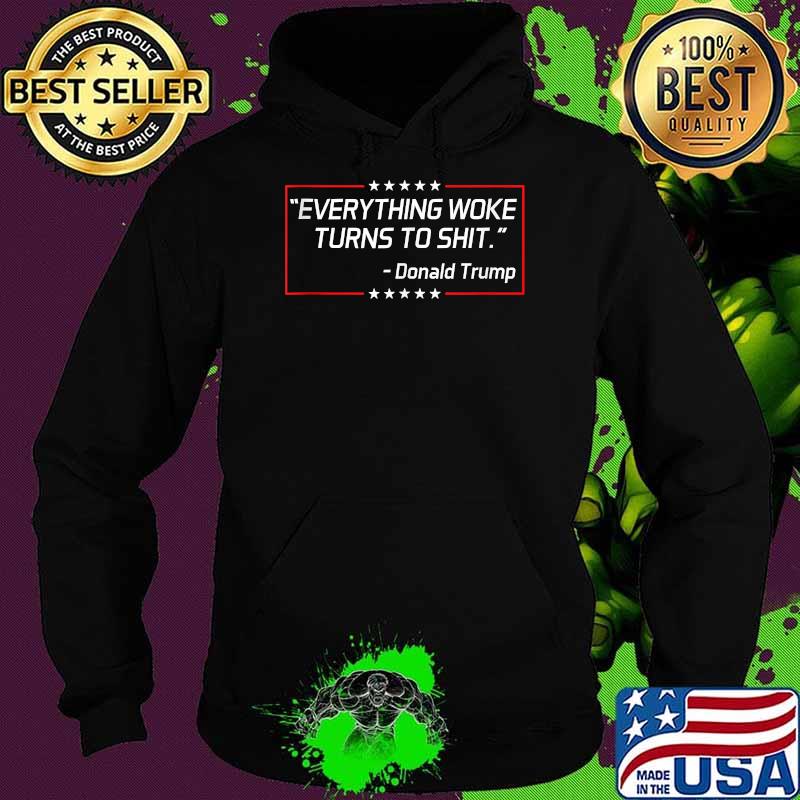
Funny Trump Everything Woke Turns to Shit Political T-shirt, hoodie, tank top, sweater and long sleeve t-shirt
For Paola de la Calle, art has been a catalyst. The Colombian-American artist has spent the Funny Trump Everything Woke Turns to Shit Political T-shirt and I love this past several months working with Galería de la Raza (a nonprofit organization based in San Francisco dedicated to promoting Xicanx/Latinx art and culture) and other groups to protest, create, and demand for the rights of Latin American migrant children detained at the border. Central to the campaign are five quilts that weave together a story of liberation, reunification, and healing. De la Calle, who often incorporates and interrogates social issues in her practice, created the quilts for the Caravan for the Children campaign, an effort aimed to influence the first 100- days of President Biden’s administration. We spoke to Paola de la Calle about her work and the importance of turning conversations into tangible actions.I grew up surrounded by a lot of very strong women that all had some type of creative process. They were always making things with their hands. From an early age, I was exposed to the power of expressing myself in creative ways and witnessed the possibility of making a living doing creative work.I think it’s interesting that it was mainly women who influenced me because we know our work is often invisible to many, but to me it was a natural part of my childhood and adulthood. I constantly wanted to express myself with art. However it wasn’t until I took a printmaking class in college and specialized in sociology that I started to make political posters and center myself on topics that I thought were important. That was the start of my understanding that art isn’t just paintings in a museum. There are other ways artists can create. There are other ways to bring art to the world. There are alternate ways to involve the public and the community like the one I come from, that maybe don’t have access to these elite institutions, but should have access to art.Imports, Exports, and Legacies, 2020. Image courtesy of Paola de la Calle.How is your creative process? What do you consider most important when creating?My work often begins with a question about the history that is being presented and, if there is a story being told, what is the story or perspective that isn’t being told? So I always begin with a question and my perspective and upbringing always influence my work. I grew up in a family of “mixed” backgrounds. My parents were undocumented, my sister was undocumented, all the the adults in my life were undocumented. I think it really changed my understanding of privilege and it also made me feel anger. For a long time, I used my anger and channeled it into my art. I also have experience as an educator so I realized that art could also be a great tool to teach.Chiquita, Picosa, y Peligrosa, 2021. Image courtesy of the artist.Tell us about Caravan for the Children, how was this project conceived?I got involved with the project through my residency at Galería de la Raza, with the idea of bringing art into this political movement. I think art sometimes does what words can’t. And the call here is to take these children out of cages and reunite them with their families. I think there is a missing step here, and that is the step of healing. These children are facing a lot of trauma. The separation from their families is very difficult and I believe that if we consider the reality that they will carry this trauma with them for many years into the future, we realize it is our responsibility. People aren’t migrating to this country for pleasure. There are a lot of policies that the United States has promulgated throughout history that now affect the living conditions in all of Latin America, especially Central America. And the notion of healing is a very important part of the conversation. This project was always very personal to me.A Poem for Keith Johnston (This Map Is Not Ours), 2020. Image courtesy of Paola de la Calle.What does the Caravan for the Children represent artistically?The quilts that I am creating for this project include the poems of 10 Central American poets that offer different perspectives on resistance, liberation, and home. Some of them imagine different futures, some of them imagine different gifts. It was important to me that these voices shined and informed the images that were created for the quilts because this isn’t something a single person can have a full perspective on. It’s about community, it’s about uniting people to work together to request the reunification and the healing of these children.What were some of the activities planned around Caravan for the Children?On May 1—the hundredth day of the Biden-Harris administration—the quilts were unveiled in Washington, D.C. The quilts allow us to imagine the liberation, reunification, and healing of the children, present us with the historic importance of this moment, and serve as an opportunity to take action.As the main artist in this campaign, it is vital to also bring in the historical narrative and politics of the work of art rather than focus on the trauma. I firmly believe that we do not need to see the violence to understand the pain, to feel empathy and want to do something about it. The quilts are really a symbol of relief and a symbol of community.March in Washington, D.C. with the quilts on May 1, 2021. Image courtesy of Paola de la Calle.What message do you want to share about Caravan for the Children?I would say that we should invest in the present to create a better future. In this case, children are particularly important because we often say children are the future, but children are also our present. What is happening today and what happens now informs what will happen in the future. That has been the case throughout history. I hope that the readers can understand that we need to invest in the lives of these children and in the way they are treated so that their future is a joyful one and real change can be made.
Be the first to review “Funny Trump Everything Woke Turns to Shit Political T-shirt”
You must be logged in to post a review.
- Length from the highest point of the collar to the bottom hem.
- Chest straight across, armpit to armpit, with the shirt laid flat.
- Sleeve from the center back of the collar to the cuff.
| Size | Length | Chest |
|---|---|---|
| S | 2871 | 1846 |
| M | 2974 | 2051 |
| L | 3076 | 2256 |
| XL | 3179 | 2461 |
| 2XL | 3281 | 2666 |
| 3XL | 3384 | 2871 |
| 4XL | 3486 | 3076 |
| 5XL | 3589 | 3281 |
| Size | Length | Chest |
|---|---|---|
| S | 2564 | 1641 |
| M | 2666 | 1743 |
| L | 26.567 | 1846 |
| XL | 2769 | 19.750 |
| 2XL | 27.971 | 21.655 |
| 3XL | 28.572 | 22.758 |
| Size | Length | Chest |
|---|---|---|
| S | 2871 | 1846 |
| M | 2974 | 2051 |
| L | 3076 | 2256 |
| XL | 3179 | 2461 |
| 2XL | 3281 | 2666 |
| 3XL | 3384 | 2871 |
| Size | Length | Chest | Sleeve |
|---|---|---|---|
| S | 2666 | 2051 | 33.585 |
| M | 2769 | 2256 | 34.588 |
| L | 2871 | 2461 | 35.590 |
| XL | 2974 | 2666 | 36.593 |
| 2XL | 3076 | 2871 | 37.595 |
| 3XL | 3179 | 3076 | 38.598 |
| 4XL | 3281 | 3281 | 38.598 |
| 5XL | 3486 | 3384 | 38.598 |
| Size | Length | Chest | Sleeve |
|---|---|---|---|
| S | 2769 | 2051 | 34.588 |
| M | 2871 | 2256 | 35.590 |
| L | 2974 | 2461 | 36.593 |
| XL | 3076 | 2666 | 37.595 |
| 2XL | 3179 | 2871 | 38.598 |
| 3XL | 3281 | 3076 | 3999 |
| 4XL | 3384 | 3281 | 39.5100 |
| 5XL | 3486 | 3486 | 40102 |
| Size | Length | Chest | Sleeve |
|---|---|---|---|
| S | 2871 | 1846 | 33.585 |
| M | 2974 | 2051 | 3589 |
| L | 3076 | 2358 | 36.593 |
| XL | 3179 | 2461 | 3897 |
| 2XL | 3281 | 2666 | 39.5100 |
| 3XL | 3384 | 2871 | 39.5100 |
| Size | Length | Chest |
|---|---|---|
| S | 2769 | 1846 |
| M | 2871 | 2051 |
| L | 2974 | 2256 |
| XL | 3076 | 2461 |
| 2XL | 3179 | 2666 |
| Size | Youth size | Length | Chest |
|---|---|---|---|
| S | 6-8 | 20.552 | 1641 |
| M | 10-12 | 2256 | 1743 |
| L | 14-16 | 23.560 | 1846 |
| XL | 18-20 | 2564 | 1948 |
| Size | Youth size | Length | Chest |
|---|---|---|---|
| S | 6-8 | 2153 | 1743 |
| M | 10-12 | 22.557 | 1846 |
| L | 14-16 | 2461 | 1948 |
| XL | 18-20 | 25.565 | 2051 |








Reviews
There are no reviews yet.