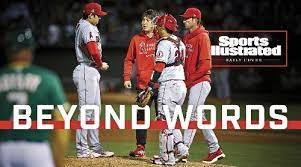
One afternoon in May, the most famous baseball player in the world was running late. Shohei Ohtani had taken the last team bus from the Angels’ hotel in Oakland to the Coliseum, as is his habit on days when he’s slated to pitch. Ohtani’s multitiered gig—as one of MLB’s most powerful hitters and flummoxing pitchers and, increasingly, the sport’s global avatar—requires an intricate itinerary. He throws side sessions before rounds of batting practice. He watches tape of that night’s opposing starter and then studies scouting reports for his own start days later. He finds himself, on occasion, on a bus alongside the Angels’ traveling secretary, his catcher, Kurt Suzuki, and Ippei Mizuhara, a 36-year-old who has never played an inning of organized baseball. On this day, that bus got stuck in a snarl of Bay Area traffic, and the group had to take the train.
ORDER PRODUCT :
Never Underestimate An OLd Man Who Loves Motorcycles And Grilling Shirt
Mizuhara is Ohtani’s personal interpreter. He has held the position since Ohtani came to Anaheim from Japan in 2018, translating for press conferences and locker-side scrums, shorthanding lines of clubhouse banter, and facilitating the fine-grain coaching sessions that help let Ohtani shape his scythe of a swing and lock in his four-seamer. That afternoon, when they reached the BART station, Mizuhara’s phone buzzed with a text from manager Joe Maddon. Should they push Ohtani’s start back a day to give him time to go through a proper warmup? Or would that mess with other elements of the routine? Mizuhara conferred with Ohtani, the two quickly weighing team and individual needs, and sent back the verdict: “Shohei’s good with thatAt its essence, Mizuhara’s job is to make sure Ohtani understands, and is understood. But the role spills beyond the banks of that description. Ohtani’s agenda—preparation, play, recovery, media availability—becomes Mizuhara’s own, with the interpreter stepping into any number of sub-duties. He speaks Japanese and English and breaks down advanced analytics and recovery timetables. “His schedule’s so unique, there are times when nobody’s around to throw with him,” Mizuhara says. “I’ll step in and play catch.”
Major League Baseball is as rich in international talent as at any point in its history. More than 28% of active players hail from outside the U.S. borders, and many of them prefer to communicate in languages other than English: Spanish, Japanese, Korean, Vietnamese, Mandarin and mashups of baseball-speak that exist somewhere in between. That figure includes superstars set to garner no small number of MVP votes (the Juniors Ronald Acuña and Vladimir Guerrero), Cy Young votes (Hyun Jin Ryu) or both (Ohtani).
The people who make this possible share few distinguishing characteristics but bilingualism and a love for the sport. They are washed-out ex-athletes or onetime megafans who made their way into pro clubhouses doggedly or accidentally. They work across rosters—as Spanish interpreters have since MLB started requiring them in 2016, at the behest of a coalition of players tired of the once-customary practice of asking this or that coach or teammate to translate part-time—or one-on-one, as is usually the case with the smaller number of players from Asian countries. The role is not particularly sought after; there is no horde of econ-degree Ivy Leaguers chasing it, as with almost every other front-office posting. But interpreters know two things better than anyone else. First, that as much as baseball is a game of skill or strength, it is a game of speech. And second, that the work of finding the right word doesn’t stop when the talking does.
In 1964, the Nankai Hawks of the Japanese Pacific League sent three players to participate in the Giants’ spring training as part of a postwar “exchange program.” During the regular season, San Francisco assigned one of these players, a pitcher named Masanori Murakami, to its Class A affiliate in Fresno, home to a sizable Japanese American community whose members provided him lodging and helped teach him English phrases. Infielder Tatsuhiko Tanaka and catcher Hiroshi Takahashi headed to Twin Falls, Idaho, for rookie ball, with no such support system. While Murakami pitched well enough to turn heads in the Giants’ front office, the others faltered, with Takahashi in particular developing a reputation for defensive miscues. He called for more offspeed pitches than his U.S. counterparts, a trademark of Japanese baseball, and struggled to grasp in-game adjustments.
In September of that year, Murakami became the first Japanese player to appear in the majors, while Takahashi completed the program and returned home. “The frustration [with the language barrier] manifested in his play on the field,” says Bill Staples Jr., the chairman of SABR’s Asian Baseball Committee. “You can see it in the box score. Two passed balls in one game, then another, then another.
SOURCE: si.
ORDER PRODUCT :